Key Takeaways
- Concussions, ankle sprains, ACL/MCL tears, meniscus tears, and hamstring, groin, and hip strains are common.
- Getting immediate medical attention is important for all injuries, but especially concussions and ACL tears.
- Practicing good sportsmanship not only makes you a good teammate, it also prevents injury.
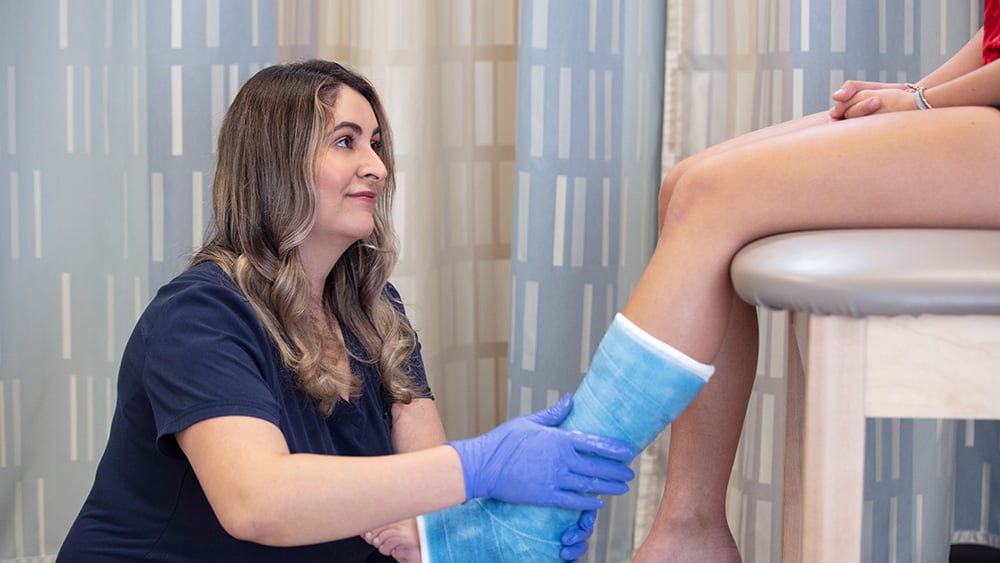
Our Orthopedic Urgent Care centers in Victor and Henrietta offer same-day treatment for unexpected injuries involving bones, joints, and muscles. With convenient walk-in hours available during the day, evenings, and Saturdays, we’re here when you need us most.
Fall kicks off soccer season – bringing thousands of young athletes out onto high school and college fields across the country.
As with most sports, injuries are bound to occur. When it comes to soccer, most of the injuries happen to the lower body, except for head injuries like concussions.
Christine Blonski, DO, is a board-certified primary care sports medicine physician at Rochester Regional Health Orthopedics – Culver who also serves as the head team physician for RIT Athletics and program director for the Primary Care Sports Medicine Fellowship at Rochester Regional Health.
Dr. Blonski shares some of the most common injuries she sees as a sports medicine physician, how they are treated, and how athletes can best prevent them.
1. Concussions
In soccer, many people think of direct impact injuries as the primary cause of concussions – two players going up for a header, a ball hitting a player’s head, or a player’s head hitting the ground. However, that is not always the case.
Concussions occur with rapid acceleration and deceleration, which also includes things like whiplash.
Symptoms vary person-to-person, but will often include:
- Dizziness
- Fatigue
- Feeling dazed
- Headache
- Nausea
- Trouble concentrating
“Some athletes might say, ‘I kind of got my bell rung’ or attribute a headache or dizziness to other causes like dehydration,” Dr. Blonski said. “They'll ignore symptoms because they don't think it could be a concussion. This is why it's important to put information in the community so people are more cautious with these types of injuries.”
Treatment
Across the board, people recover very well from concussions. Most concussion recovery includes:
- rest
- good quality sleep
- limiting physical activity
- limiting screen time
About 90 percent of athletes over the age of 18 will recover within 2 weeks. For young athletes under 18, it will take closer to a month. Athletes will need to be cleared by cleared by a qualified medical provider to allow safe return to play not coaches or athletic administrators. This often involves evaluation and supervised progression in return to physical activity to ensure symptoms don't return with advancing activities once the athlete feels they are at their baseline at rest.
If not cared for properly, concussion symptoms can linger. Once a concussion is sustained, the lifetime susceptibility of brain to concussion is higher for those athletes compared to athletes who haven’t suffered a concussion.
“Young children are expending significant amounts of energy every day. They have to divert energy they would normally use for growth and development to recover from an injury,” Dr. Blonski said. “Being patient with recovery from concussion in younger kids is really important.”
2. Ankle sprains
Players will often be running in the field during a practice or match and suddenly roll their ankle, either by tripping or pivoting quickly. That rolling motion stretches out the ligaments that stabilize the ankle, which causes swelling and pain.
Treatment
In the first 24 hours after an ankle sprain, follow the RICE protocol: Rest, Ice, Compression, and Elevation. Most athletes will recover in 3-4 weeks with physical therapy exercises and a brace as needed for stability and support.
“Your body needs to be re-trained to reduce the likelihood of reinjuring your ankle,” Dr. Blonski said. “Physical therapy can guide you with specific exercises that will not only help you recover but prevent additional injury.”
Younger, non-high school-aged athletes with ankle injuries are at risk for growth plate fractures instead of ligament damage. Because of this risk, it is important to get ankle injuries for these younger athletes checked out by a medical provider to rule out fracture to ensure proper orthopedic specialty care if a fracture is detected.
3. ACL injuries
Ligament injuries to the knees are one of the biggest fears for most athletes.
Anterior cruciate ligament (ACL) tears often happen with quick stops, twists, or pivots – but can also come from contact with other players if the knee buckles backward. The force from that movement places too much stress on the ligament in the center of your knee, causing it to tear.
Most athletes will hear a popping sound and see immediate swelling.
Treatment
After an x-ray and MRI to determine the extent of the injury, an orthopedic surgeon will need to repair the torn ACL. This which means a minimum of 6 months for recovery.
More than 90 percent of athletes who decide against reconstruction often have chronic knee instability, early on-set arthritis, and other major joint health issues.
“Primary care sports medicine physicians will provide expedited consultation with surgical colleagues to ensure reconstructive surgery isn't delayed,” Dr. Blonski said. “They will also coordinate therapy to ensure the initial inflammation, swelling, and range of motion of the knee is restored prior to undergoing surgical reconstruction. This helps to optimize post-surgical recovery, bridging care during the gap in time from onset of injury to surgical day.”
4. MCL tears
For soccer athletes, a tear of the medial collateral ligament (MCL) usually occurs from any lateral shifting motion in the knee that can happen when changing directions or with a direct blow from the side of the knee that can happen with slide tackling.
The MCL is on the inner side of the knee, so the swelling that occurs with MCL injury is different than the swelling with an ACL tear, but can still be quite significant. Both injuries can occur simultaneously in some cases. Athletes can sometimes hear a popping sound, feel some tenderness inside the knee, and feel like their knee might give out if they put weight on it.
Treatment
An MCL injury usually does not require surgery. Lower grade MCL injuries may take 4-6 weeks to heal, while more severe tears can take at least 3 months.
Orthopedic specialists will often give patients a brace to stabilize the ligament and support the joint with activity. Physical therapy can help to restore strength and function as the body repairs the ligament over time.
5. Meniscus tears
The meniscus is a C-shaped disc of soft cartilage that helps to cushion the movement between the knee and shinbone. Because soccer involves a lot of twisting and turning, the cartilage inside the knee can become damaged over time or tear acutely with change in direction.
Meniscus tears can lead to a lot of swelling and pain that comes from deep inside the knee, often leading to a feeling of instability.
Treatment
Because meniscus is made of soft cartilage, an x-ray cannot detect any tears but it can rule out additional injuries. Athletes will need to undergo an MRI.
Many meniscal tears will require surgical intervention to correct instability. Orthopedic specialists will then usually have patients rest and ice the affected knee, and do physical therapy exercises to restore mobility and strengthen the muscles and ligaments around the meniscus after surgery. A full recovery takes about 3 months.
“Unfortunately, severe meniscus injuries may not fully heal on their own, which can lead to recurring instability,” Dr. Blonski said.
6. Hamstring, groin, and hip strains
With a sport like soccer, players are constantly running and sprinting down the field – changing direction and moving suddenly.
Muscles and ligaments along the groin, hamstring, and hips can become strained and need time to recover.
Treatment
Athletes should do their best to modify their movements to avoid injuring the muscles or ligaments further. Physical therapy exercises can help to strengthen the affected area and reduce additional strain.
If an athlete is not recovering after 3-4 weeks, they should see an orthopedic specialist to determine if the injury might be more serious.
Preventing soccer injuries
No matter what sport you are playing, training your body matters. Before you start practicing and doing conditioning, meet with a primary care provider to be cleared.
Use the right equipment: Wear light, breathable clothing on hot days and stay hydrated. Make sure your shin guards and cleats fit well so there is no extra room for rolling an ankle, having areas where friction may cause blisters, or taking a hard shot to the leg.
Warm up your body: Get your body ready for practices and games by stretching out and warming up all the muscles that you are going to be using.
Learn the proper technique: Know the best way to head the ball, change direction when dribbling, and so on. Coaches and athletic trainers know about proper technique, so pay attention to them.
Fuel your body: Food is fuel. Getting proper nutrition to play to key to playing well. Don’t skip breakfast – you’ll be drained later in the day. If the weather is going to be hot, be sure you’re hydrated.
Play by the rules: The rules exist for a reason. Even a moment of letting out frustration can lead to unexpected injury for yourself or another player.
“Don’t play dirty,” Dr. Blonski said. “It plays a big role in injury prevention for yourself and other players. Being a good sport matters.”

Related Articles