
Key Takeaways
- An aortic dissection is a life-threatening cardiovascular condition that requires immediate care and often surgery to repair.
- Patients feel severe back pain or a ripping or tearing sensation in their chest and immediately know something is wrong.
- Heart and vascular surgery teams work closely together to ensure the best possible outcomes for each patient.
Aortic dissection is a life-threatening cardiovascular condition where the aorta – the largest artery in your body – suffers a small tear in its inner lining. An aortic dissection often requires immediate repair by a surgical team.
While relatively rare, roughly 13,000 people die of aortic dissections each year, according to the Journal of American College of Cardiology. Recently, Senator Lindsey Graham suffered an aortic dissection and died at age 71.
“It is a relatively rare diagnosis, but because of the life-threatening nature of it, we obviously take it extremely seriously,” said Ryan Lydon, MD, Interim Service Line Division Head of Vascular Surgery for the Sands-Constellation Heart & Vascular Institute at Rochester Regional Health.
What happens in an aortic dissection
The aorta is the largest artery in the human body and carries blood from the heart to circulate throughout the rest of the body.
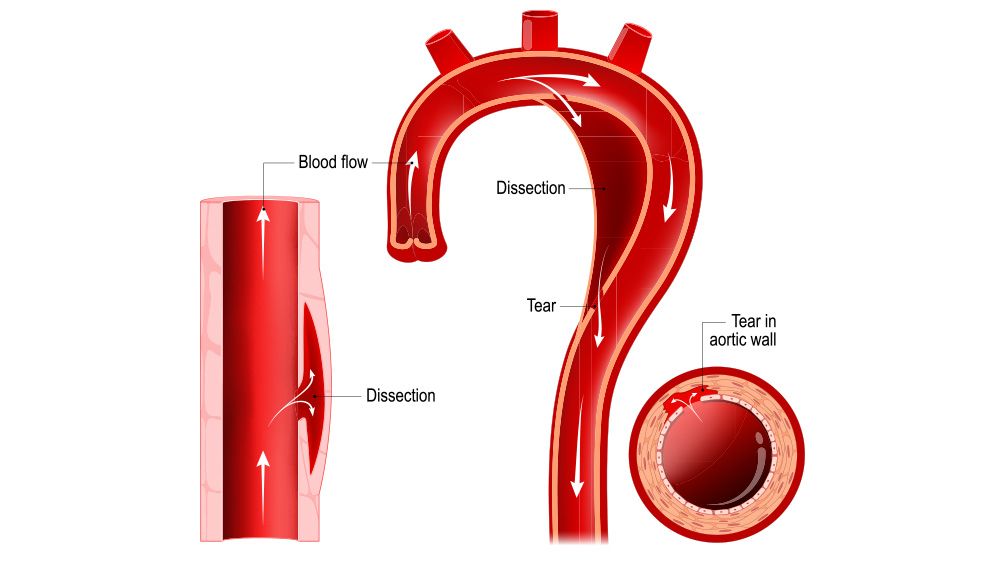
With an aortic dissection, a small tear occurs in the inner lining of the aorta.
“When that occurs, blood rushes into the tear and separates the wall of the aorta even more,” Dr. Lydon said. “When this occurs, the aortic wall becomes destabilized and this can result in a rupture of the aortic wall, which is usually a fatal event.”
This can also block or affect blood flow to other organs in the body, which can also be a life-threatening emergency.
There are two types of aortic dissection: Type A and Type B.
Type A: Ascending aortic dissection
Type A aortic dissection originates in the upper aorta (ascending) near the aortic valve, which sends blood up from the heart.
This is very dangerous and usually requires emergency open heart surgery to repair.
Type B: Descending aortic dissection
Type B aortic dissection happens in the lower aorta (descending thoracic) where blood is being sent down to organs such as the kidneys and liver.
This type of aortic dissection blocks or affects blood flow to other organs throughout the body and legs.
“There are also some patients who suffer aortic dissections which have components of both types,” Dr. Lydon said. “These cases often require complex, multidisciplinary care between cardiac surgeons, vascular surgeons, and other multifaceted teams from radiology to cardiology.”
Symptoms of aortic dissection
Patients usually feel a ripping or tearing sensation in their chest or back that is described as “abrupt” or “severe”, according to Dr. Lydon. Back pain is also common.
“Immediate medical care is needed, ideally at an institution like the Sands-Constellation Heart & Vascular Institute that is capable of handling complex, multidisciplinary cardiovascular care,” Dr. Lydon said.
Causes of aortic dissection
Heart-related risk factors like high blood pressure and smoking contribute the most to the underlying conditions that cause aortic dissection.
These conditions can increase the risk of narrowing arteries and other blood vessels, along with the buildup of plaque.
Anyone who may be at risk of developing heart disease or a heart condition should talk with their primary care provider about their risk.
Who is at risk?
Men over the age of 60 who have an existing heart condition or heart health risk factors are among the highest risk for an aortic dissection.
Other risk factors for aortic dissections include:
- Being a current/former smoker
- High blood pressure
- High cholesterol
- Family history of high blood pressure or cholesterol
- Rare genetic conditions such as Turner syndrome, Marfan syndrome, artery inflammation
“Rochester Regional Health has a heart health risk stratification tool online that can be helpful for patients who are looking for general knowledge about their risk,” Dr. Lydon said.
How doctors treat an aortic dissection
An aortic dissection requires an acute, immediate response from a surgical team.
Patients with symptoms of an aortic dissection should immediately call 911 and visit the nearest emergency department.
Surgical treatment options for aortic dissection are on a vast spectrum depending on the type and extent of dissection.
For Type A aortic dissection, heart surgeons will usually perform emergent open heart surgery. This involves opening the chest and placing the patient on cardiopulmonary bypass in order to replace the affected segment of torn ascending aorta. Patients who have a successful repair will spend 1-2 weeks recovering in the hospital before having their cardiac care team approve them to be discharged.
Type B aortic dissections can typically be repaired by vascular surgeons using a minimally invasive procedure. Surgeons will access the aorta through blood vessels in the groin, using tiny catheters to bring a stent up to the affected area of the aorta and cover the torn area. Hospital stays are usually shorter compared to a Type A dissection patient but still vary from patient to patient.
“At the Sands-Constellation Heart & Vascular Institute, you are going to receive a high level of comprehensive care across the whole heart and vascular team,” Dr. Lydon said. “We work side by side every day, we have amazing relationships with each other and are able to move quickly in caring for these types of conditions so patients can have the best possible opportunity to recover.”

Related Articles





.jpg?h=563&iar=0&w=1000)