Helping You Get Answers with Greater Confidence
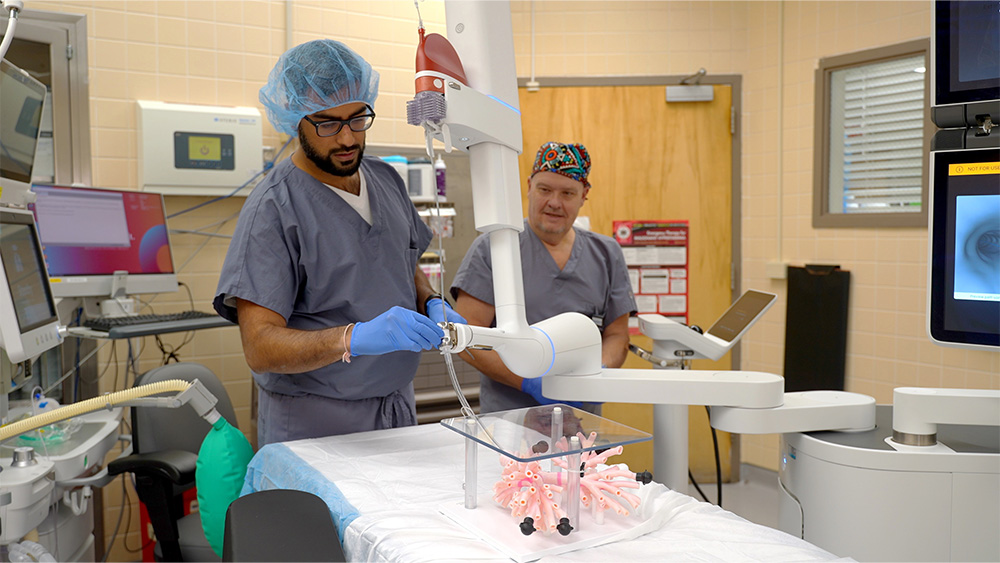
Robotic bronchoscopy is an advanced, minimally invasive procedure that helps detect lung disorders, such as interstitial lung disease, sarcoidosis, and lung cancer, earlier and with greater precision. Using a thin, flexible bronchoscope with robotic guidance, providers can accurately perform biopsies, place markers, and plan treatment while reducing discomfort and speeding recovery.
Lung cancer is the leading cause of cancer deaths in the U.S. but finding cancer early often means we can treat it. Take our health risk assessment and see if you are eligible for our non-invasive lung cancer screening.
Benefits of Robotic Bronchoscopy
Early detection matters.
Stage I lung cancers have up to a 92% five-year survival rate, compared to 10% at Stage IV (2024 data).
Advanced Technology.
Robotic systems enhance control and navigation, enabling precise access to targeted areas of the lung.
Greater Precision.
Ultra-thin, flexible instruments allow accurate sampling of small, hard-to-reach nodules for earlier diagnosis.
Ion Robotic-Assisted Bronchoscopy
Available in the St. Lawrence Region
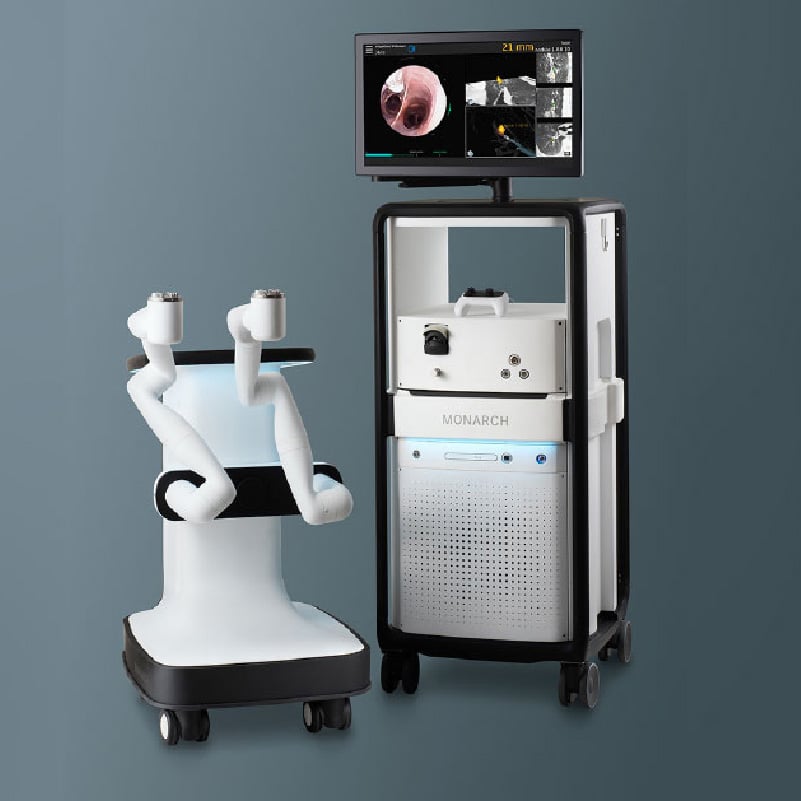
We are proud to offer the Ion endoluminal system at our Canton-Potsdam Hospital, an advanced robotic-assisted platform for minimally invasive lung biopsies. Traditional methods can struggle to reach small or hard-to-access lung nodules. With this innovative technology, our team can navigate deep into the lungs with precision, helping detect and diagnose conditions, such as cancer, earlier and more accurately.
What Patients Can Expect
The Ion system uses a thin, flexible catheter and advanced robotic guidance to access and biopsy small or challenging lung nodules, improving diagnostic accuracy while minimizing disruption to healthy tissue. Patients are typically under sedation or anesthesia, and most go home the same day with minimal recovery time. Key benefits include:
Robotic navigation allows providers to reach areas of the lung that were previously difficult to access. This precision reduces the risk of complications and supports more confident diagnostic decisions.
The Ion system enables the collection of high-quality tissue samples from small or hard-to-reach nodules. This helps providers make faster, more reliable diagnoses and treatment plans.
Fred’s Story:
Early Detection Through Robotic Bronchoscopy
When Massena resident Fred Hartford was referred for robotic bronchoscopy services, he didn't expect that the technology would be key to detecting lung cancer early - and giving him a path forward.
Read More

Schedule with your primary care provider or search for a provider that meets your needs.
Related Articles